



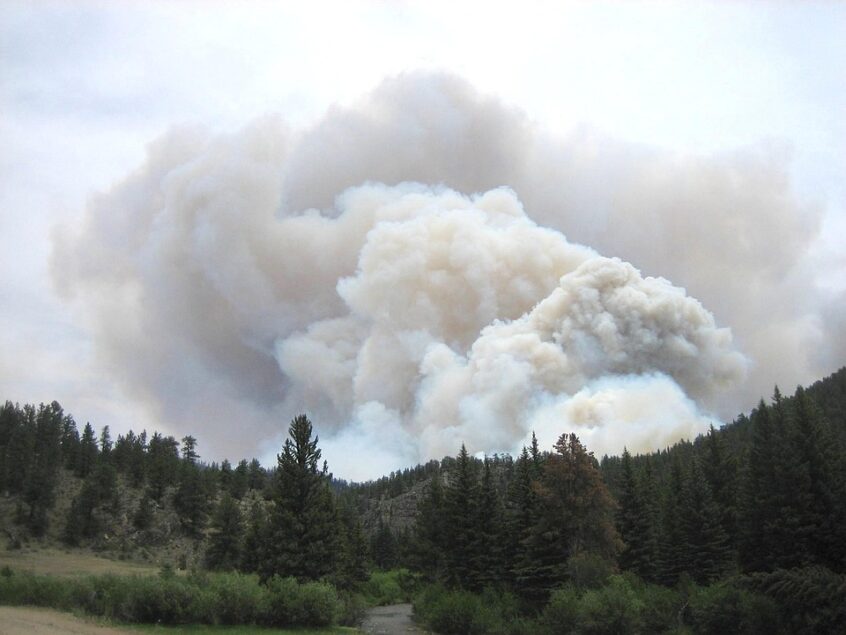
We’re well into wildfire season and our VA/VC Medical Staff Planetary Health Committee wants us to know the risks so we can protect our health and that of our patients. We turned to VMDAS/VPSA member Dr. Emily Brigham for advice. She’s a respirologist at Vancouver General Hospital as well as an associate professor in the respiratory division at the University of British Columbia and a research scientist at Vancouver Coastal Health Research Institute. Dr. Brigham is also part of Legacy for Airway Health’s scientific team; her research focuses on the impact of air pollution on lung health.
“I want to figure out who has the highest risk when it comes to exposure to wildfire smoke and then design and test interventions to reduce that risk,” said Dr. Brigham. “Whether that’s helping them to avoid exposure or testing interventions that boost their resiliency to exposure… that’s the intersection where my research lives.”
While it’s easy in BC to equate wildfire smoke with burning forests, wildfires can happen anywhere including industrial settings where potentially dangerous pollutants can be released into the air. Whatever is burning translates into what is released into our air: it’s a complex mix of gaseous pollutants and particles containing chemicals and toxicants.
“If you can see or smell smoke, the health risk is considered high. Smoke can travel thousands of miles from its source. Even if you can’t see or smell smoke, that doesn’t mean there’s no risk,” cautioned Dr. Brigham. “What’s encouraged from a public health standpoint is to check your air quality during wildfire season frequently, more than once a day, if possible, because things change.”
Air quality in Canada is reporting through the Air Quality Health Index (AQHI). The AQHI provides an hourly rating of air quality based on the health risk from three air pollutants: particulate matter less than 2.5 microns (PM2.5), ground-level ozone (O3), and nitrogen dioxide (NO2). During wildfire season, the AQHI is largely influenced by PM2.5, released in high concentrations from fires. The BC Centre for Disease Control’s website has extensive information about wildfire smoke including several fact sheets.
“BCCDC’s site tells you how to interpret the AQHI: how to modify your activity based on whether you’re in a healthy population or a potentially susceptible population,” said Dr. Brigham. “The advice is if you’re having symptoms you need to get to cleaner air.”
Dr. Brigham also recommends we download the federal government’s WeatherCAN app and that we also reference the University of Northern BC’s air quality map, which provides hourly PM2.5 observations from federal monitoring stations as well as from numerous low-cost sensors that have been deployed across Canada—many in areas where federal monitors are unavailable. She encourages us to share this information with our patients so they can be better informed. She also notes that physicians can prescribe air cleaners to patients with severe chronic respiratory ailments.
What are the symptoms of potential health hazards from wildfire smoke? These include shortness of breath, coughing, nasal, throat and/or eye irritation, and chest discomfort. These indicators can be experienced by people who are healthy. People with underlying medical conditions may be at an enhanced risk. Those with heart disease and lung disease may be more likely to have exacerbations of their disease as a result of wildfire smoke exposure. Several other groups are known to have a heightened susceptibility to wildfire smoke including children under the age of five, pregnant people, and those over the age of 65.
The known health effects of wildfire smoke include strokes, heart attacks, arrhythmias, and asthma and COPD exacerbations. Higher concentrations of particulates in the air may cause some people to have an increased susceptibility to infections. There is also data coming out about potential for pre-term labour and early birth in pregnant populations.
“The particles in wildfire smoke, just like the particles in other forms of air pollution, are what is tied most closely to most of the health effects we see,” said Dr. Brigham. “Smaller particles can move more deeply into the respiratory system. When I inhale, the larger particles are going to deposit mostly in my upper airway, whereas the smaller particles can go down farther into the lungs and even translocate into the bloodstream.”
What research has still to verify are the chronic impacts of wildfire smoke exposure.
“We’re still learning about that; wildfire smoke is trickier to model because events are less predictable and air pollution concentrations fluctuate,” said Dr. Brigham. “There’s epidemiological data starting to tease out if there is a relationship with cancer and dementia, and there is also some evidence of lung health effects in wildland firefighters who have repeated, high-level exposures. The answers to these questions can then be incorporated into public health guidance.”
Dr. Brigham encourages us to promote empowerment for our patients when it comes to exposure to wildfire smoke.
“Focusing on preparation is really important. Knowledge is power; teaching people how to check their air quality and respond makes a difference. Physicians know their patients and can start these conversations.”
Mapping planetary health initiatives
The VA/VC Medical Staff Planetary Health Committee invites physicians, nurse practitioners, and other medical staff who are leading planetary health initiatives that impact the VA and VC communities of care to complete a form that intends to map these various projects.
The goal is to identify and connect existing sustainability efforts, build a network of green champions, and establish a knowledge exchange forum to share learnings and amplify impact across our health-care community. Committee members invite you to share information about any current or planned initiatives related to planetary health or environmental sustainability in your area of work.
The role of green teams in health-care institutions
Check out this Canadian Cardiovascular Society podcast in which VA/VC Medical Staff Planetary Health Committee Chair Dr. Matthew Bennett interviews Dr. Richard Cook on his experience with the cardiac sciences green team at VGH. Their conversation includes ideas on how to set up your own green teams.