



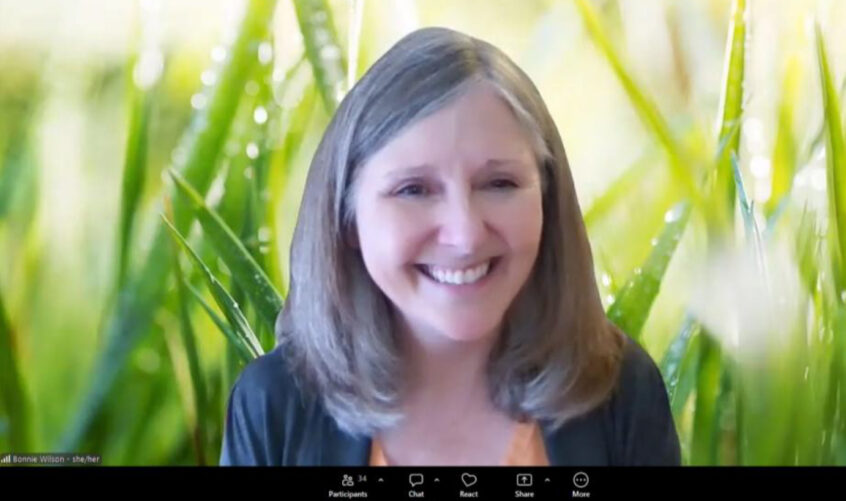
There are moments in all our careers when we wish we knew then what we know now. For VCH Vice President, Vancouver Community Bonnie Wilson, one of those moments came early in her professional life. She was working as a speech language pathologist in the Yukon and noticed that several of her Indigenous clients were hesitant about working with her. She was mystified when she saw one mother fleeing out her back door when Bonnie arrived for an appointment. This was in the mid-1990s and knowledge about residential schools, the impacts of colonization and intergenerational trauma, and Indigenous peoples’ negative experiences with the health and social services were not widely known or talked about. Today Bonnie believes she would have had a different way of doing things if she had known then what she knows now.
This was just one anecdote that Bonnie related to medical staff attending the recent Dinner with Leaders event hosted by Dr. Anna Borowska of VPSA’s Community Building & Wellness Task Group.
Vancouver Community overview
Bonnie began her presentation by talking about the Vancouver Community portfolio, where she has been the vice president for about a year. She is grateful to work with a wonderful team including VC’s Senior Medical Director Dr. Michael Norbury, and executive directors Tarnjit McCauley and Yasaman August.
Bonnie shared information on VC’s many sites and the breadth and depth of its services. The city is divided into six local health areas (West End, DTES & Grandview Woodlands, Northeast, Kitsilano and Fairview, Midtown, and South) delivering services out of 60 different locations. She mentioned a few jaw-dropping numbers: her team is responsible for more than 5,000 long-term beds (the equivalent of 1,505,200 bed days per year), and provide home support to over 6,800 clients, which adds up to 1,875,900 visits each year. There are 27,900 clients who fall under Mental Health and Substance Use Community, accounting for 297,200 annual visits.
Her leadership journey
Bonnie recalled her early years growing up in Winnipeg where she was the youngest of four children. The family also spent a couple of years living in a small community in northern Manitoba. She admired her mother for her caring attitude and is grateful to her parents for instilling a sense of being grounded and not taking herself too seriously. When deciding on a career path she knew she wanted to accomplish three things: ease suffering, do no harm, and be in service to others.
Bonnie received her master’s degree in speech language pathology (SLP) from McGill and her first job was working as a SLP community outreach worker in the Yukon. Eventually she moved to the Lower Mainland where she has held several positions within VCH. These include an education and patient services manager at GF Strong and, later, leading region-wide strategic initiatives including our COVID-19 testing and vaccination response. She was an executive director with VC before taking on the role of vide president.
During the pandemic, she had the pleasure of serving with another Bonnie—Dr. Bonnie Henry and commented on how that time made her realize she was living the mission she gave herself at 18 to be in service to others.
Dyad leadership
Bonnie is a strong advocate for dyads, which she says are near and dear to her heart. Her first chance to participate in one came when she was director of services for the Downtown Eastside community and she appreciated the strength that came when operations leaders and medical staff and leaders work together.
She notes that operations leaders benefit from dyads because medical leaders are smart people who are doing clinical work with teams. Medical staff and medical staff leaders benefit because, despite the many hoops that must be jumped through, operation leaders get things done. She was especially pleased to work with Dr. Norbury on developing dyad relationships within VC.
Attendees’ questions
- What keeps you up at night?
- Care for seniors: there are not enough long-term beds, and this affects the entire health-care system. There needs to be a more robust plan in place on how to keep pace as the population ages. We are putting in more home supports to keep people in their homes as they age but we need a massive home-support workforce.
People with mental health and substance use challenges: we need the right kinds of services and supports and a continuum of care.
Our workforce: we need good work environments where people feel valued. We take pride in our work, and we need to be excited about going to work every day.
- What challenges have you found in working in a dyad in your career?
- Medical staff/leaders and operations leaders often don’t have the same schedules. Physician leaders have amazing ideas, but there often feels like there’s an expectation that once you’ve shared your idea, we’ll make it happen quickly. There are many hoops to jump through.
It’s important to get to know one another and understand each other’s pressures and challenges.
- You appear to have a boots-on-the-ground philosophy. Where would we be likely to encounter you in your day-to-day work? Where is your office?
- The reality is that is tough because there are so many sites in VC and it’s a challenge to get out to these. My happy place is going to sites and being with staff and clients.
My office is at 520 West 6th Avenue. I try to be an approachable leader, so feel free to reach out to me directly. In an effort not to undermine other leaders though, I typically ask if your medical director and operational leaders can also be brought into the loop..
Survey feedback
Five of the 31 medical staff members who attended the session completed the post-event survey. Everyone agreed they now have a better understanding of the VC VP’s role, and they all felt they had an opportunity to ask questions. The session earned a healthy net promoter score of 60 per cent. One respondent noted that they would have liked to have heard more about the challenges Bonnie faces in her work.
Ideas for other events?
We want to hear from you about ideas for VPSA events and/or workshops. Share your brainwaves with us and we’ll direct your suggestion(s) to the relevant VPSA committee or task group for their consideration and action. Please complete this form. Let’s care, connect and collaborate!