



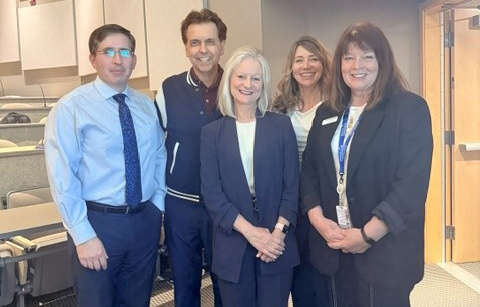
Amazing things can happen when you have the right people in the right place at the right time. So it was when VMDAS members met in person and online to learn more about patient access to imaging at the association’s May 25th quarterly meeting. The session, hosted by VMDAS President Dr. Adam Meneghetti and entitled Why can’t my patient get a scan? Imaging Access in 2026 and Beyond, featured guests Dr. Alison Harris, Regional Department Head, Medical Imaging VCH & PHC, Dr. Savvas Nicolaou, Department Head, Medical Imaging VGH & UBCH, Susan Larson, Executive Director, Medical Imaging, and Gail Malenstyn, Vice President, Vancouver and Richmond Acute. VCH Special Projects Director Kyle Eckhardt was also available to respond to some of the issues raised by members. While many concerns remain, some key areas were addressed with at least one pebble in the shoe resolved for many physicians.
Dr. Harris provided an overview of Medical Imaging’s scope of operations, key data points, including CT and MR! volumes and operating hours, capital equipment, staffing levels and radiologist protocoling. It is well known that scan demand at VGH and UBC Hospital exceeds current capacity and Dr. Harris’s presentation outlined the reasons. These include a shortage of qualified staff, aging and outdated equipment, along with an aging population and increasing demand. The department is working on several strategies to increase throughput and improve access including increasing capacity, improving efficiency, reducing demand for “low-value” imaging, prioritizing capacity, and integrating AI.
Discussion ensued regarding ways physicians could emphasize the urgency of a patient’s imaging needs. Physicians making the requisition should provide as much clinical information as possible as this can help with prioritization. Including a timeframe within which you would like the imaging to occur can also be helpful.
It became clear that physicians would also like a feedback mechanism so they know how their request has been prioritized. Several members expressed frustration at not knowing where their patients are in the queue. Medical Imaging shared that it was implementing provider notifications based on recommendations received by the Administrative Burdens Working Group, sponsored by Ministry of Health and Doctors of BC. VA/VC ordering providers are eligible to enroll to the MI Provider Portal whereby they can view the status of all active imaging requests.
Medical Imaging is working to modernize the requisition and protocoling process. At this time, appointments are confirmed with patients, but the system does not communicate that information with the physician who made the request. Medical Imaging is trying to create a dashboard that will provide this information.
The department is now able to notify patients of MRI and ultrasound appointments via text messaging and plans to expand that service to all modalities. There is work going on at the provincial level to have providers also receive this information.
Communication with providers working in the community was also raised, as these physicians are not on Cerner and community imaging clinics do not upload reports to CareConnect. This poses a significant barrier to radiologists who are trying to view these images and who need to see them before they do further studies. The Ministry of Health is aware of this, and it will require significant funding to have these clinics connected.
Medical Imaging has drafted a statement of work to build an orchestrated agentic workforce to help with decision making, prioritization, and scheduling. This is an AI tool that can consider a vast amount of data and provide a summarized recommendation to an ordering provider or to a radiologist that considers what higher exams need to be done. The tool can look at a patient’s history and their conditions, their lab work, and allergies and provide information that it would take a person hours to assemble on their own.
Health human resources affect all aspects of our operations; VCH is not alone in finding it challenging to recruit and retain staff. The number of spaces is increasing at post-secondary institutes to help alleviate this and Medical Imaging is not alone in trying to figure out different staffing models using the resources it has. For example, LPNs now help in CT and ultrasound. Aides now do a lot of the pre-prep work and assist patients. The department is recruiting internationally educated technologists and works closely with the Talent Acquisition team.
Member feedback
Twenty-two of the 150 members who attended the meeting completed the post-event survey.
Some findings:
- Over 80 per cent of respondents felt the presentation improved their understanding very well or extremely well of current imaging capacity challenges and expected changes over the next 12 to 24 months.
- Everyone felt the session provided useful and actionable information that they can apply in their practice as a referring clinician to help improve imaging access for patients.
Two topics were suggested for future quarterly meetings:
- IT solutions for the hospital
- Antibiotic resistance patterns and concerning trends