



Since the introduction of nurse practitioners (NPs) into BC’s health-care system in 2005, the profession has grown rapidly. Here at VCH, under the guidance of Department Head Jennifer Buck, more NPs are onboarded every year and their work touches all areas: from surgical to medical services, in both Vancouver Acute and Vancouver Community as well as other communities of care within VCH. As of October 9, 2026, 74 nurse practitioners work in VA and 107 in VC, with more being onboarded between then and the end of the year. In celebration of Nurse Practitioner Week, VPSA spoke with four NP members who are making critical contributions to patient care.
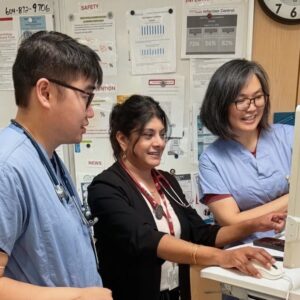
From left: Nurse Jeffrey Ma, and Cardiac Surgery NPs Menaka Ponnambalam, and Patti Choy.
NP Menaka Ponnambalam joined the Cardiac Surgery unit at VGH a little over a year ago. With 18 years’ experience in cardiac surgery as a nurse practitioner in Toronto and Ottawa, Menaka took a leave from the University of Ottawa Heart Institute to explore working in Vancouver. When a position came up at VGH, she never looked back.
“I’ve always worked in cardiac surgery, first as a nurse and then as a nurse practitioner,” recalled Menaka. “My role focuses on the specialized care patients need as they recover from surgery from the time they leave the ICU until their discharge. This involves managing acute and chronic medical conditions and preventing and treating complications to allow patients to regain their health and independence. I think that as we increasingly offer surgery to older, more complex patients, a field of specialized perioperative care has evolved. Over the course of my career, I’ve seen surgeons innovate in cardiac surgery, and NPs are matching this with an equally modern approach to medical management, recovery, and the longer-term health of our patients. We each contribute a different perspective and set of skills; together we provide very comprehensive care.”
As an NP, Menaka sees her role as not only caring for the patient but also supporting the staff and the surgeons. She is grateful for the collegial relationships she has had with her physician, surgeon, nursing, and multidisciplinary colleagues.
“Collegiality is so important. Nurse practitioners are independent clinicians, and I think it is important to emphasize that we provide additive care not assistive care,” said Menaka. “NPs bring another lens to patient care, and when that expertise is welcomed and combined with that of our colleagues, the impact can be so much more meaningful.”
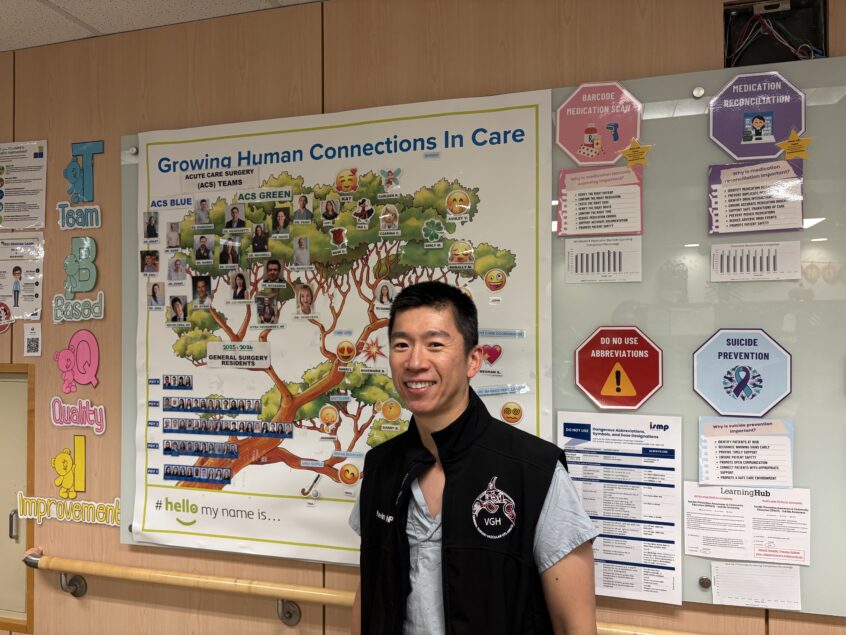
Over in General Surgery, NP Kevin Chen makes significant contributions to Acute Care Surgery’s smooth operations. He’s been part of the team there since 2023; his nine years as a nurse practitioner have been split between there, VGH’s thoracic surgery and lung transplant service, and 1.5 years in Fraser Health on vascular surgery.
“My work is very dynamic and very chaotic and never has a dull moment, said Kevin. “I manage all the patient care that comes before and after surgery. Managing the complications on the ward is the hard part. Surgery itself is kind of like a sprint, but everything else is a marathon. The majority of what I do is patient management to make sure the patients can go home safely in a timely manner.”
Kevin says there is a lot of overlap between what physicians and NPs do, but it’s the collaboration between the two professions that can create excellent results in patient care.
“Surgeons need to be very surgery-focused,” he added. “For best patient care, they need somebody else who thinks differently to look at the same issue with a different lens. As an NP, I speak the language of the nursing profession, so it’s easier for communication to happen. In health care, good communication can really make or break things.”
Kevin returned to school for his nurse practitioner degree because he did not want to stagnate.
“I think there’s so much that NPs can offer; there’s still a lot of ground to be broken,” he said. “NPs still have a lot more to put on the table, and I think NPs, along with everybody else, can make the health-care system stronger in BC. It’s time to push ourselves to be innovative and to push our boundaries.”
Nurse practitioners are also making life easier in Emergency Departments. At UBC Hospital, NP Darlene White has been on the job for about a year. The department triages patients into those needing acute attention and those who are put in the rapid access zone, which is where Darlene primarily works.
“As an NP, I see patients who can wait a bit longer and this helps with the flow,” said Darlene. “I try to take time with patients and really listen to what their concerns are. If a person has a lot of concerns that they’re continuing to bring up and continuing to come to Emergency for, I try to help them to prevent them from returning or direct them into the right care area for follow-up.”
Darlene likes the constant learning required of a nurse practitioner to stay up to date. She also appreciates the autonomy she has.
“I don’t need a physician to look over my work; I run as an independent provider,” she said. “I’ve seen lots of acceptance and appreciation from the emergency physicians because it really does help with flow, and, at the end of the day, it’s all about the patients. The emergency physicians at UBC are fantastic and have really been helpful for integrating NPs into patient care.”

NP Shaveta Bolina.
Vancouver Community is also benefiting from nurse practitioner expertise. NP Shaveta Bolina has worked in two Urgent and Primary Care Centres in VC since she joined VCH about a year ago. She started at the UBC UPPC and now works at Vancouver City Centre UPPC.
“In urgent care settings, NPs are responsible to assess, diagnose, plan, and treat,” said Shaveta. “The idea is that a UPCC is a step down from emerge, but a step up from primary care. We do smaller procedures, little incision drainage, smaller sutures—something that is not appropriate for emergency but needs to be seen today. We assess patients, diagnose them and provide treatment. Counselling is also part of the job, particularly at UBC where we see a lot of students during exam season.”
Shaveta explains that in UPCCs, NPs provide full scope urgent care.
“One of the ways NPs contribute to increasing patient access is by being available in urgent care settings and family practice,” she said. “We all know there is a shortage of primary care providers, and a lot of people aren’t attached to a family physician or NP.”’
Shaveta is also a member of both the VCH Regional Medical Staff Equity Committee and VPSA’s VA/VC Equity, Diversity and Inclusion Committee.
“I learned about the committees during our orientation,” recalled Shaveta, “and I wanted to part of something outside of work. I’m really enjoying representing a nurse practitioner’s perspective. The acceptance of the physician members of the committees makes me feel hopeful that I’m creating a platform for other NPs in the future.”
Top photo: Nurse Practitioner Kevin Chen.