



People with substance use disorder make up a significant number of patients admitted to VGH. Substance use disorders and related mental illnesses, behavioural disorders, and stigmatization can present tremendous challenges and barriers to hospital-based care for both patients and staff. These can lead to poor patient experiences, worse outcomes, added medical expenses, and provider workload, frustration, and stress.
VPSA’s Substance Use Disorder Patient and Provider Experience Task Group is aiming to make a difference to these marginalized patients through a number of programs including the recently launched Complex Pain and Addiction Services (CPAS) Snack Program. Physicians working with CPAS patients can request a couple of snacks per week per patient that are delivered via Volunteer Services. The pilot program is funded by the VGH and UBC Hospital Foundation.
“Little gestures like providing snacks mean so much to the patients,” said Dr. Adam Chodkiewicz, who co-chairs the task group with Dr. Jan Hayek. “When you connect with a patient, when they feel that they’re not just somebody filling a bed but that they matter to you, it can make a real difference. There’s a bigger connection in these gestures. It’s a way of letting patients who are marginalized know that we care about them. I think it probably has an impact on the overall quality of their spirits and how they view staff.”
The CPAS research team will measure the pilot program’s impact as part of a quality improvement project.
“I’m wondering if the program—and others we’re considering implementing—will impact patients not leaving against medical advice,” added Dr. Chodkiewicz, “or impact patient code whites or compliance to medications and things like that. It will be interesting to look at some of the data from a QI perspective and see if it improves a patient’s overall journey.”
Once Dr. Chodkiewicz has the data to back this up, he hopes to expand the program to other parts of the hospital where patients who are marginalized are treated. He would also like to see the program adopted in other hospitals within VCH. He sees the program as also benefiting medical providers by bridging the gap between them and their patients.
“Anecdotally, many of the physicians who have ordered snacks have been pleasantly surprised about the reaction the patients have,” said Dr. Chodkiewicz. “They say things like, ‘their affect was brighter.’ It’s hard for us to do the little extras within the health system; this is a way of us doing a little bit extra.”
The task group also has funding through the foundation for the CPAS TV Access Program, which will provide access to TVs for up to five patients who are marginalized at any one time. While this does not meet the overall need, it is a foot in the door and will allow for data to be gathered to measure the program’s impact. Unfortunately, technical difficulties have meant the project is yet to get off the ground.
Once these programs are well established, the Substance Use Disorder Patient and Provider Experience Task Group hopes to turn its attention to other opportunities. Currently under consideration is a shoe or sock program. Some of the committee members work in the Emergency Department and see patients arrive without shoes.
Dr. Chodkiewicz’s hopes are high. He’s seen firsthand the difference small gestures can make and how it can be the little things that open connections and give patients who are marginalized reason to hope.
“We want all our health providers to have the ability to make those connections,” he said.
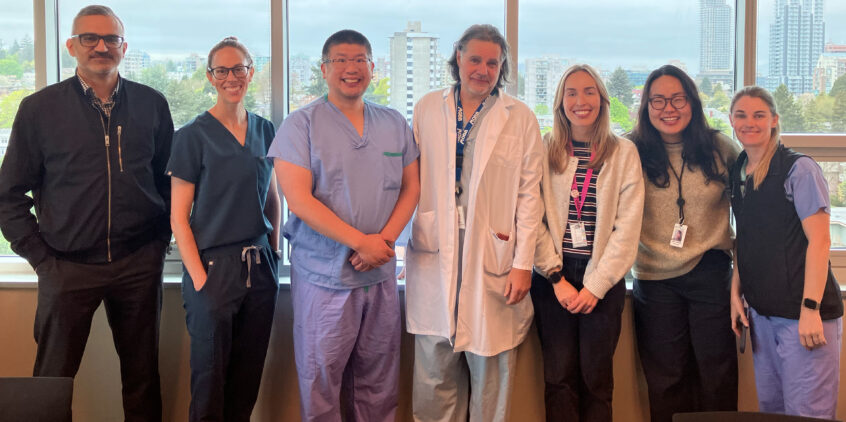
Photo: The CPAS/Psych CL group.