




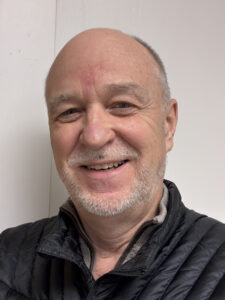
 Physicians, Reverend Doug Longstaffe says, are foremostly trained in facts, philosophers in thoughts, and spiritual care professionals in feelings. His work—and that of the staff he leads as regional director of Spiritual Care and Multi-faith Services at VCH—blends facts, thoughts, and feelings as they work together in the crisis of illness.
Doug was VPSA’s guest at its January Dinner with Leaders event, which was facilitated by Drs. Lucy Lyon and Fahreen Dossa. Doug passed quickly over his life before landing on spiritual care (he worked for Air Canada moving planes around on the tarmac; he sold magazine subscriptions door to door; he drove a cab) and what he’s currently reading (You are the Placebo: Making Your Mind Matter by Joe Dispenza).
Doug spent many years in academia and was a minister before integrating his spiritual work with health care. Along the way, he developed an avid interest in the humanization of institutions and has spent many years advocating for greater recognition of the spiritual dimension in health care. He is passionate about integrative mind/body approaches and adheres to the theory that the more you know yourself, the more you can help others. Self-awareness, he says, helps us connect better with patients and colleagues.
Doug reports directly to VCH’s president and has a team working with him that includes spiritual health practitioners and education leaders overseeing a clinical psychospiritual education program. He also supervises care delivered by Catholic and Anglican providers who work within VCH (the Ministry of Health only pays for interfaith spiritual care).
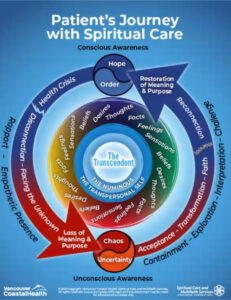 Doug spoke at length about a patient’s journey with spiritual care and the feelings that come to the surface over time. These range from hope and order to chaos and uncertainty followed, hopefully, by a restoration of meaning and purpose. His staff accompany patients on this journey, providing rapport and an empathetic presence as well as assisting patients with containment, exploration, interpretation, and meeting challenges. Patients, he explains, experience a wide range of emotions during their illness, and are often confused. This requires sorting and embracing the unknown.
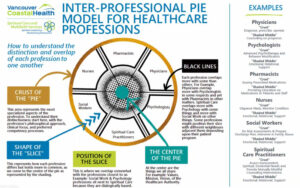 Doug also shared the inter-professional pie model for health-care professions, which demonstrates the distinction and overlap of medical staff roles including those of physicians, nurses, pharmacists, psychologists, social workers, and spiritual care practitioners. Each profession overlaps and, at the centre of the pie, are the shared values, mission and vision of our health authority. In contrast to pyramidal models the model is non-reductionistic in recognizing the distinctives of each profession. Doug referenced the book Slow Medicine by Victoria Sweet and commented on the special role physicians have and the power of our words, particularly in delivering news.
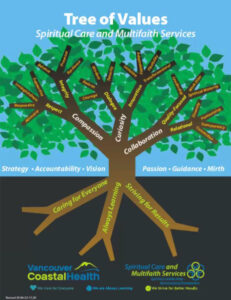
Spiritual Care and Multi-Faith Services has created its own tree of values, which is based on VCH’s values (caring for everyone; always learning; and striving for results). Components include strategy, accountability, vision, passion, guidance, and mirth, while its branches represent compassion, curiosity, and collaboration and everything that follows from those.
Doug concluded his presentation by noting that we work in a health-care system that, although necessary, has a tendency of systems to dehumanize, like all institutional systems. Community, within the system and outside of it, he believes, has the potential to humanize systems and keep them effective as well as efficient.
Members’ questions
A physician who works in Vancouver Community asked Doug advice on how to assist a patient who appears to have no spiritual side to their life.
Doug noted there are spiritual care staff in many long-term care facilities as well as palliative care. It can be difficult to provide help when a patient is not associated with a clinic, but he suggested physicians contact him directly to discuss details and to see what he can do.
Another question was regarding how the chapel/prayer room at VGH is used. They’ve noticed people coming and going.
Doug replied that his staff only hold services there if a family makes a request. The Catholic priests who visit the hospital hold services and Indigenous Elders also use the space regularly. His team is currently working on a policy. VCH Spiritual Care also holds memorials in special circumstances affecting our staff and patients like the tragic event following the Lapu-Lapu Day festival.
A physician who works with vulnerable populations is aware of the power of language and communication. She noted that she uses certain phrases regularly and wondered if there are expressions that work well for connecting with people.
Doug noted that his education team has a list of 100 words that are common in spiritual care and have particular meaning. However, every situation is unique. He suggested people reach out to him if they have a singular situation in mind. He also encouraged physicians to remember that we have incredible power with our words, particularly in how we break news and the possibilities that come with that. Rather than running from this power, Doug asks that we embrace it and use it to the betterment of our patients.
A physician raised the issue of the culture of medicine and how, as students and residents, we are never evaluated on how we speak with patients or listen to them.
Doug suggested VPSA arrange a workshop on what doctors can do to improve patient care without adding more time to their day.
Another member noted that this could rejuvenate our work as reciprocity in our relationships with patients is professionally fulfilling.
A question was asked regarding spiritual care for ourselves and what is available from Reverend Doug’s team.
He replied that, while he’s found physicians to be pretty tough and self-reliant, everyone needs someone to lean on. His staff are here for physicians and are happy to open a dialogue and provide perspectives without judgement. Spiritual care can provide a non-anxious presence that is calming and accepting. He encourages physicians to reach out.
A community physician working in a medical clinic often treats patients with serious illnesses with uncertain outcomes. They see the need for spiritual care but find it hard to start such a conversation with patients.
Doug responded that every conversation is contextual, and suggested physicians explain their role to patients including an offer to broach the question of spiritual support as appropriate to holistic care and the role of a physician within that matrix. He encouraged physicians to welcome patients in expressing their thoughts and feelings. Doug noted that this would also be a area on which his program could develop a course for docs. He invited the physician raising the question to email him for a more substantive response. He also welcomed any physician to email him f0r follow up to any of their questions.
Getting in touch
Doug can be reached at Doug.Longstaffe@vch.ca.
The general email address for the team is spiritualcare@vch.ca.
VCH’s Spiritual Care and Multi-faith Services main office is on the second floor of the Doctors Residence at VGH (2775 Heather Street).
The office phone number is 604-875-4151.
Spiritual Care and Multi-Faith Services staff members are onsite at all three Vancouver Acute facilities (VGH, UBCH and GF Strong) as well as a person connected with the Vancouver Community palliative care program and another with the Home Health program and some of VC’s long-term care homes.
The service is anonymous; records are kept about workload measurements, but no notes or personal information of staff/physicians supported are kept.
Resources
A Short History of Spiritual Care at VGH
Five Steps to Authentic Partnering: Addressing Issues of System and Community
The Inter-Professional Pie Model: An Alternative to Pyramidal Approaches
Explanation of Swirl Model of Patient’s Journey with a Spiritual Care Practitioner
Event feedback
The session was attended by a diverse group of physicians from the Departments of Family Practice, Medicine, Psychiatry, Gynecology, and Emergency Medicine with the session earning an 80 per cent net promoter score. Everyone who took the post-event survey agreed that they now have a better understanding of Doug’s role at VCH and how it provides support to, and engages with, medical staff.
Comments about what resonated most from the presentation included:
- We can access his services.
- Really practical points made and information given.
- How accessible spiritual support is; don’t use it as much as I should.
- Very approachable.
Ideas for other events?
Dinners with Leaders is an initiative of VPSA’s Community Building & Wellness Task Group. We want to hear from you about ideas for VPSA events and/or workshops. Share your brainwaves with us and we’ll direct your suggestion(s) to the relevant VPSA committee or task group for their consideration and action. Please complete this form. Let’s care, connect and collaborate!